
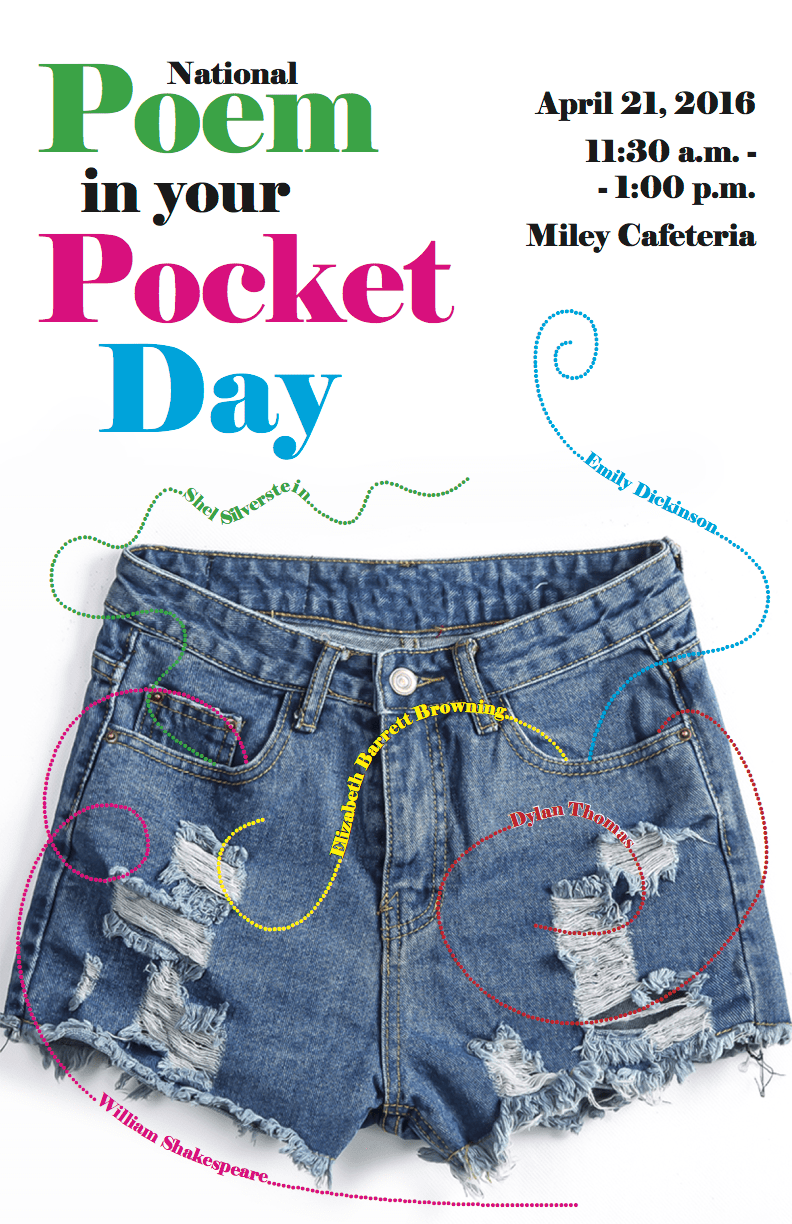
Every April the Academy of American Poets promotes Poem in Your Pocket Day, which is pretty much what it sounds like: “People celebrate by selecting a poem, carrying it with them, and sharing it with others throughout the day at schools, bookstores, libraries, parks, workplaces, and on Twitter using the hashtag #pocketpoem” (Poem in Your Pocket Day 2016). The librarians at McKillop Library at Salve Regina University have a special fondness for poetry, and use National Poem in Your Pocket Day to connect with students, faculty, and staff. Beth Blycker Koll, Evening Circulation Supervisor created this poster to promote the day and their event. Here’s Beth discussing her design:
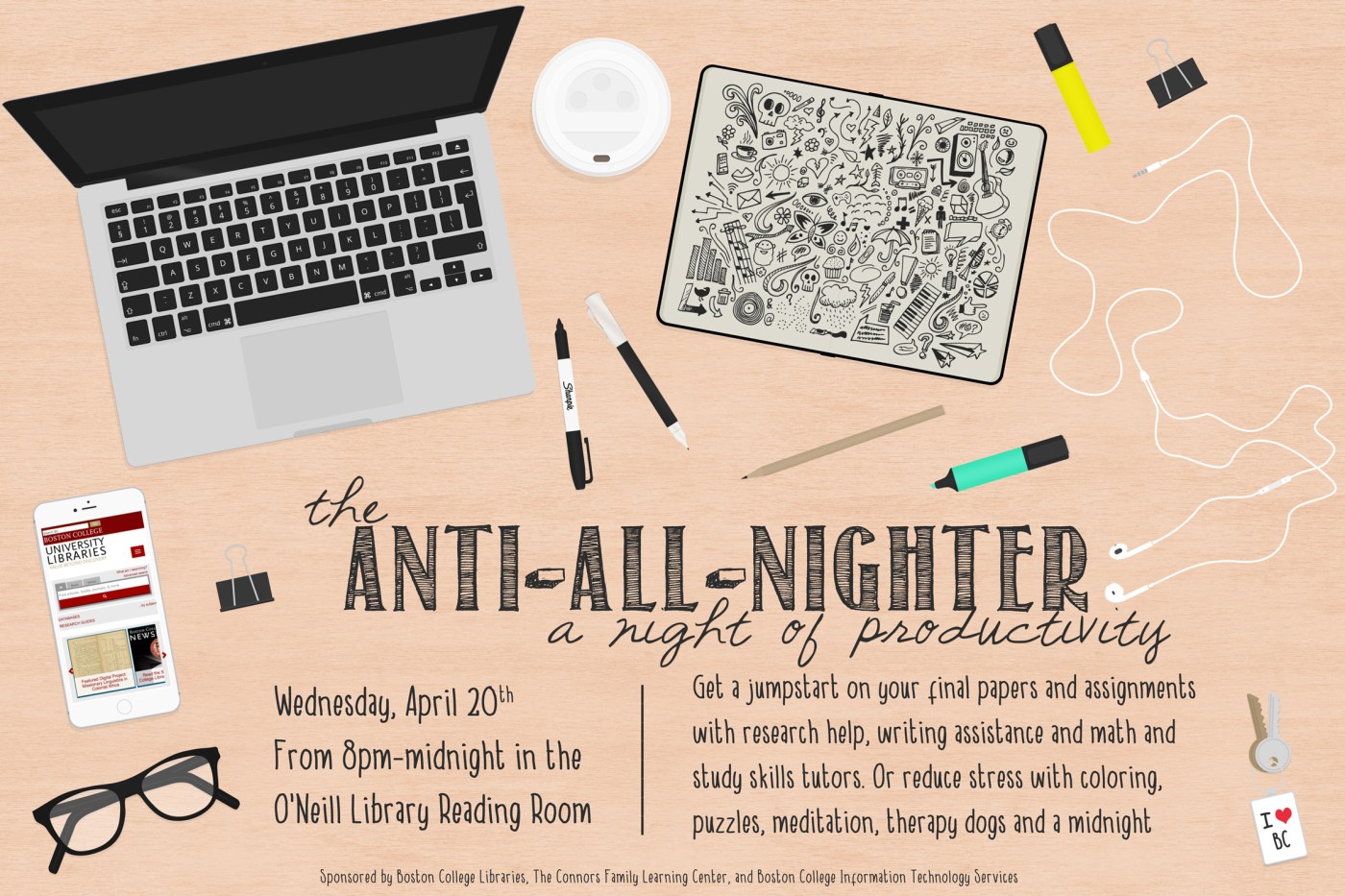
As we continue to make our way through finals week and the end of another academic semester, it’s clear that you are doing some amazing outreach work at your libraries. Earlier this week we shared the emerging trend of The Finals Fairy, a benevolent creature whose power lies in its ability to bring sugary snacks to stressed out students. A bit less magical, but just as effective, are libraries that seek to help take some of the stress out of the end of the semester with study break activities and research and writing help.
Ashley Chassé at the Boston College O’Neill Library did an amazing job promoting her library’s Anti-All-Nighter program with this lovely poster. Here’s Ashley discussing her design:

It’s that time of year again. The stress levels are high, the self-care activity is low, and college students everywhere could use an extra 8 hours in everyday. It’s final week, and if your library is anything like mine, it’s quiet and full of ultra-focused students.
Today’s design from Jess Burkhardt, Public Services Librarian at the DeSales University Trexler Library, was inspired by the work of librarians at Salisbury University, Michigan State University, and Lafayette College, who all worked hard to bring the magic of The Finals Fairy to their hard-working students.

We all want to find ways to reach out to students and faculty who don’t regularly come to into the library. Heather Darnell, Library Media Specialist at Northern Virginia Community College-Annandale, found a very cool way to do this: pop up research desks!

There is no shortage of data to describe the work we do in libraries each year. The challenge is to use those numbers and statistics to paint a meaningful picture of our libraries’ values, missions, and goals, and how we work to accomplish them. Today’s post features a new academic librarian’s first attempt at making sense of data using a mashup of infographic styling and statistical charts.
Jess Burkhardt, Public Services Librarian at DeSales University’s Trexler Library created this design using Adobe Illustrator to share 2014-2015 library statistics with her campus community. Here’s Jess describing her design process:
This infographic was conceived in moment; my Director asked if I thought that students would find our annual statistics interesting in their current form on a library Libguide. “Sure, they might – if they find them at all,” I said, “but an infographic might go over better.”
And my infographic endeavors began. Though graphic design has my heart in a whole bunch of ways, I knew that there was a lot about design that I did not know. As I worked my way through an Adobe Illustrator course on Lynda.com I began considering what information to include and the design of the project. Graphical representation of our library proved difficult. I considered symbolizing each of our student workers, librarians, and databases, but each of my visualizations were unable to convey the extent of the information that we had collected. I drew many sketches on different sizes of paper and filled artboard after artboard with drawings in Illustrator just to find that my drawings of books looked exactly like Word art–a compliment that I did not readily accept.
This infographic went through many different phases. Images took a disproportionate amount of space, the message wavered between screechy and barely heard at all. After a lot of frustration and a looming deadline I decided to streamline what I had and came up with the final product. It is displayed throughout the Trexler Library, drew a lot of traffic to our Facebook page, and has been placed in our annual report.
This project excites me because it has introduced me to the world of Adobe Illustrator and Library Design Share. I’m excited to be joining your community and am already considering my next design project!
We’re excited to share Jess’ design. If you have any questions about it, you can contact her via email, or leave a comment below.

April and I make no secret of the fact that we are always on the hunt for design inspiration. Whether it be an interesting magazine ad, quirky product packaging, or sweet wrapping paper, no web or print graphic element escapes our notice. It’s no surprise then, that Pinterest is a never-ending blackhole for us. As a source of font, color, and style inspiration it’s unparalleled, and also a dangerous way to spend several hours in pursuit of the right idea for our next button/flyer/poster/display/etc.

Some of my least favorite teaching moments are those focused on mechanics: Click here; scroll there; point at this; type on that space. Jenica Ibarra, Reference & Instruction Librarian at St. Petersburg College-Clearwater Campus uses Canva to get around the mechanical aspects of library instruction to focus on more substantive teaching:

If your library’s reference collection is anything like ours, it’s likely:
- underused
- overlooked
- full of fantastic info that makes librarians drool
My fantastic colleague, Amanda VerMeulen, recently created a series of shelf signs to try to draw attention to our in-need-of-more-than-a-little-love reference collection.
 Librarian Design Share